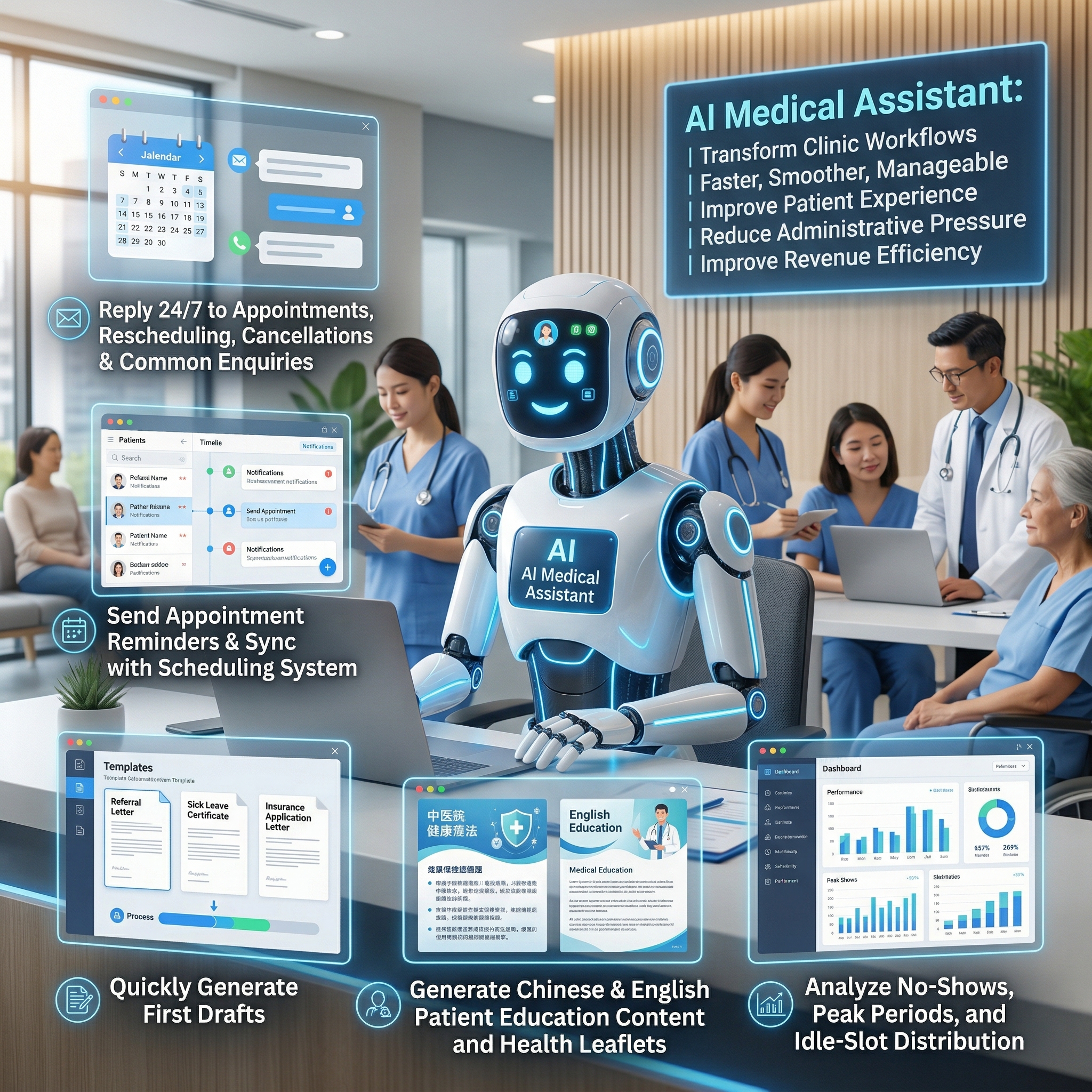
An AI Administration and Patient Service Platform Designed Specifically for Hong Kong Private Clinics and Medical Institutions
From appointment enquiries, rescheduling and cancellations, patient reminders, document drafting, patient education content, and administrative analysis to schedule optimization, GoPeople AI Medical Assistant transforms high-frequency, repetitive daily work that easily slows down clinic operations into executable, manageable, and traceable AI intelligent workflows.
Designed specifically for Hong Kong private clinics and medical groups, it helps teams reduce front-desk and assistant administrative pressure, improve patient experience, reduce no-shows, improve scheduling efficiency, and achieve measurable operating returns within 5-8 months.
AI Medical Assistant is not a single chatbot or writing tool, but an AI operations platform that integrates appointments, reminders, documents, patient education, and administrative analysis, allowing clinics to shift time away from repetitive administrative work and reinvest it in patient service and quality of care.
OMNISENTI AI
What Clinics Most Easily Waste Is Not Just Manpower, but the Entire Appointment and Administrative Process
Hong Kong private clinics handle a large number of high-frequency administrative workflows every day that easily interrupt work: front-desk staff answer appointment calls, handle rescheduling and cancellations, manage patient waiting and on-site flow, deal with no-shows and late cancellations, medical assistants draft referral letters and sick leave certificates, prepare patient education leaflets, and follow up on medical insurance and document requirements.
If these tasks rely on manual handling over the long term, they directly increase administrative costs, slow down clinic operations, and also affect patient experience and revenue efficiency.
- Front-desk calls take up a large amount of time
- Scheduling and idle-slot management are not accurate enough
- No-shows reduce revenue efficiency
- Doctors and assistants spend too much time on non-clinical documents
- Poor waiting experience affects patient satisfaction and return rates
- Administrative costs keep rising, while operating efficiency does not improve at the same pace
What Can AI Medical Assistant Do?
AI Medical Assistant transforms common high-frequency clinic administration and communication work into faster, smoother, and more manageable intelligent workflows:
- Reply 24/7 to appointments, rescheduling, cancellations, and common enquiries
- Send appointment reminders and sync with the scheduling system
- Quickly generate first drafts of referral letters, sick leave certificates, and insurance application letters
- Generate Chinese and English patient education content and health information leaflets
- Analyze no-shows, peak periods, and idle-slot distribution
- Improve patient experience, reduce administrative pressure, and improve revenue efficiency
45%↓
Reduction in overall operating costs
30%↑
Increase in patient satisfaction
5-8 months
Average ROI payback period
Value One: AI Appointment Bot Handles Appointments 24 Hours a Day
AI Medical Assistant includes the SmartAsk appointment assistant, which can handle appointment enquiries, rescheduling, cancellations, common questions, special request records, and automatic reminder notifications through WhatsApp, the website, or other channels.
Patients only need to enter “I’d like to book orthopedics next Wednesday afternoon, is there any availability?” and the system can instantly check open time slots, confirm the appointment, record special requests, and sync back to the clinic system, so front-desk staff and assistants no longer have to spend long periods occupied by phone calls.
- Appointment handling time reduced by 80%
- Front-desk call volume reduced by 70%
- Front-desk and assistant appointment workload reduced by 70-80%
- Reduce missed appointments and repeated handling
- Patient satisfaction increased by more than 30%
Value Two: AI Document and Patient Education Content Generation
AI Medical Assistant can quickly generate first drafts of referral letters, sick leave certificates, medical insurance application letters, patient education leaflets, bilingual Chinese and English health explanation content, and simple explanatory materials for common conditions based on the key points provided by the doctor.
For example, by entering “chronic lower back pain, office worker,” the system can quickly generate a simple bilingual patient education leaflet that includes causes, lifestyle advice, and when to seek medical attention, helping improve patient understanding and compliance.
- Letter drafting time reduced by 75-85%
- Patient education material preparation time reduced by 90%
- Doctors and assistants can reduce non-clinical administrative work
- Patients can more easily understand and follow treatment advice
- Improve overall communication efficiency and professionalism
Value Three: AI Administrative Analysis and Scheduling Optimization
AI Medical Assistant can analyze past appointment data, consultation time slots, no-show patterns, peak periods, idle-slot distribution, and reminder effectiveness, clearly identifying which time slots are busiest, which have the most idle gaps, which days have higher no-show rates, and whether new slots should be added or reminders strengthened.
The system does not just give you numbers, but provides more concrete optimization suggestions so that every consultation chair can generate higher value.
- No-show rate reduced by 40%
- Effective consultation time increased by 25%
- Administrative revenue leakage reduced by 30%
- Easier to optimize scheduling and reminder strategies
- Allow every consultation chair to generate greater revenue value
AI Medical Assistant vs Traditional Clinic Administration Model
Comparison Item
Traditional Method
AI Medical Assistant
Appointment and Rescheduling Handling
Relies on front-desk staff answering calls, manually checking time slots, and recording appointments and changes, which can easily lead to missed appointments, repeated handling, and peak-hour chaos.
Can handle appointments, rescheduling, cancellations, and reminders instantly 24/7, sync back to the scheduling system, and record special requests.
Medical Document Drafting
Doctors and assistants need to manually draft referral letters, sick leave certificates, and insurance application documents, which is time-consuming and highly repetitive.
Can quickly generate first drafts of non-clinical documents, allowing doctors to focus on review and patient service.
Patient Education and Communication
Requires manual preparation of patient education content and health explanations, which takes a long time and may not be presented consistently.
Can quickly generate Chinese and English patient education content and simple informational leaflets, improving understanding and compliance.
No-show and Scheduling Management
Mainly depends on manual observation and experience-based adjustments, making it difficult to quickly identify which time slots are most wasted or have the highest no-show rates.
Can analyze no-shows, peak periods, and idle-slot distribution, providing more concrete scheduling and reminder recommendations.
Revenue Efficiency and Administrative Burden
A large amount of time is spent on front-desk calls, administrative follow-up, and non-clinical documentation, reducing actual consultation and revenue efficiency.
Compresses repetitive administrative hours, allowing the team to devote more time to patient service and effective consultation periods.
Which Medical Institutions Are Best Suited for Implementation?
Private Clinics
Handle large volumes of appointment calls, rescheduling, cancellations, and patient enquiries every day, and need to reduce front-desk pressure.
Specialist Clinics
Need to handle scheduling, reminders, and patient document communication more clearly.
Medical Groups
Want to standardize appointments, documents, education content, and operating analysis methods.
High Patient-volume Clinics
Want to reduce no-shows, improve time-slot utilization, and enhance patient experience.
Management That Values Administrative Relief and Revenue Efficiency
Want to exchange fewer administrative hours for more stable consultation revenue and better process efficiency.
AI Medical Assistant Implementation Process
Step 1
Analyze Existing Clinic Workflows and Main Pain Points
First review the most time-consuming parts such as appointment handling, rescheduling and cancellations, patient reminders, document drafting, and no-show management.
Step 2
Organize Scheduling Rules, Document Templates, and Patient Communication Materials
Organize scheduling methods, reminder workflows, commonly used documents, educational content, and frequently asked questions into a usable foundation.
Step 3
Build Appointment, Document, and Content Automation Capabilities
Configure the appointment bot, reminder workflows, non-clinical document generation, and patient education content capabilities to match actual clinic scenarios.
Step 4
Integrate Existing Scheduling and Administrative Workflows
Connect WhatsApp, the website, the scheduling system, and existing front-desk / assistant workflows as needed.
Step 5
Set Permissions, Privacy, and Data Security
Set permissions for front-desk staff, assistants, doctors, and management roles, while configuring encryption, backup, and data boundary mechanisms.
Step 6
Pilot and Optimize
First pilot in designated clinics, specialties, or workflows, and adjust appointment logic, document formats, and reminder strategies.
Step 7
Official Deployment and Continuous Expansion
After launch, gradually expand to more doctors, more clinics, and more administrative scenarios, continuously increasing ROI and patient experience benefits.
What Truly Improves Is Not Just Administrative Efficiency, but Overall Clinic Revenue and Patient Experience
- 70-85% reduction in administrative time
- 45% reduction in overall operating costs
- 30% increase in patient satisfaction
- 40% reduction in no-show rate
- Average ROI payback in 5-8 months
When appointments, reminders, documents, education content, and time-slot analysis become smoother, clinics directly benefit from lower front-desk and administrative costs, fewer no-shows and revenue leakage, higher utilization of effective consultation periods, and better patient experience and return rates.
Why Choose OMNISENTI AI?
We do not only provide an appointment chatbot or a single AI tool. Based on the real-world scenarios of Hong Kong private medical institutions, we integrate appointments, reminders, documents, patient education, and administrative analysis into an AI operations platform that can be practically implemented.
This AI HUB has already been localized for Hong Kong private medical institutions’ privacy regulations, appointment workflows, and patient communication habits. Combined with enterprise permission management, data encryption, and automatic backup mechanisms, it can go live in as little as 3-7 days, allowing you to quickly see obvious administrative relief, improved patient experience, and revenue improvement.
Frequently Asked Questions
It is suitable for high-frequency clinic scenarios such as appointment enquiries, rescheduling and cancellations, reminder notifications, patient education content, referral letter drafting, sick leave certificates, and administrative analysis.
Yes. The system can integrate with WhatsApp, the website, and existing scheduling workflows according to actual needs, helping handle appointments and enquiries 24/7.
Yes. The system can help generate first drafts of referral letters, sick leave certificates, insurance application letters, and other non-clinical documents for doctors to review before use.
Yes. The system can quickly generate bilingual Chinese and English patient education content and health information leaflets that are easier to understand, based on the key points provided by the doctor.
Yes. Through automatic reminders, scheduling analysis, and pattern recognition, the system can help clinics reduce no-shows and late cancellations.
No. AI mainly handles high-frequency, repetitive, and standardized work, allowing front-desk staff and assistants to focus their time on on-site service and more important support work.
The system can work with role-based permissions, data encryption, controlled access, automatic backup, and audit trail mechanisms, supporting privacy and data protection requirements for medical institutions.
Because clinics have a large number of high-frequency, standardizable appointment, reminder, document, and administrative workflows. As long as administrative hours are effectively reduced, no-shows are lowered, and time-slot utilization is improved, ROI is generally easier to quantify.