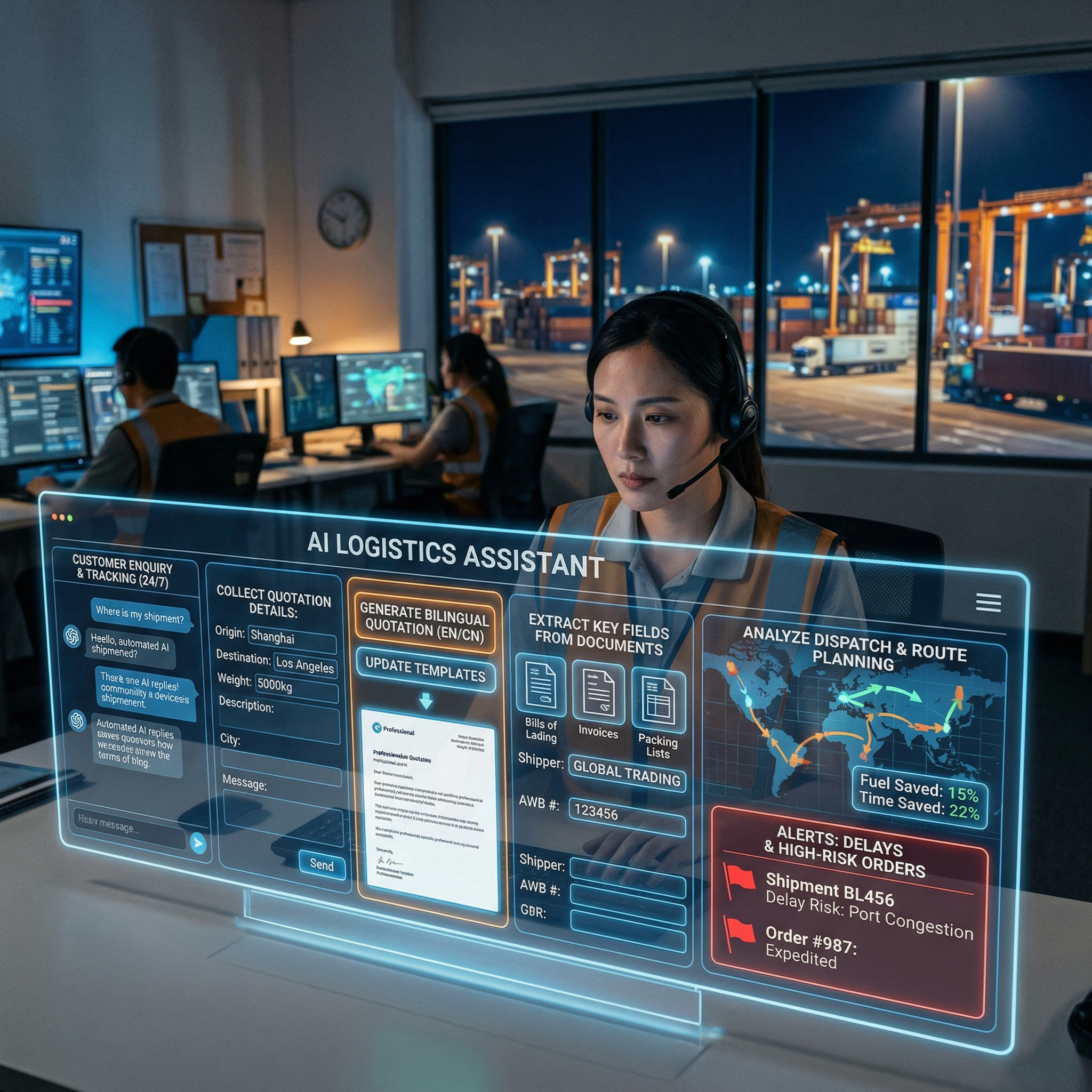
An AI Automation Operations Platform Designed Specifically for Logistics Enterprises
From customer enquiries, quotation generation, shipment updates, document processing, route optimization, risk alerts, and exception notifications, GoPeople AI Logistics Assistant transforms highly repetitive, error-prone, and time-sensitive daily work into executable, manageable, and traceable AI-powered workflows.
Designed specifically for real logistics operating scenarios, it helps teams reduce customer service and administrative costs, improve on-time performance, enhance customer experience, and achieve measurable operational returns within 6 months.
AI Logistics Assistant is not a single tool, but an integrated operations platform that combines AI chatbots, AI assistants, content generation, document processing, and risk analysis, allowing logistics enterprises to shift time away from tedious administrative procedures and back toward sales, delivery, and business growth.
OMNISENTI AI
What Logistics Companies Really Lose Is Not Just Cost, but Response Speed and Delivery Efficiency
Logistics companies handle a large amount of high-frequency, real-time, cross-department work every day: customers asking where their shipments are, sales teams manually preparing quotations, customer service handling delay notices, document teams organizing bills of lading and invoices, dispatch and route planning, exception risk tracking, and internal coordination.
Once these processes rely heavily on manual handling, several typical problems often arise:
- High enquiry volume makes it hard for customer service teams to respond immediately
- Quotation and document preparation are slow, affecting conversion
- Route planning is not optimized enough, increasing fuel and time costs
- Delays and exceptions are discovered too late, damaging customer experience
- Administrative and customer service teams remain occupied with repetitive tasks
- Costs keep rising, while service quality does not necessarily improve in parallel
What Can AI Logistics Assistant Do?
AI Logistics Assistant transforms the common high-frequency operational work of logistics enterprises into faster, more accurate, and more consistent intelligent workflows:
- Reply to customer enquiries and shipment tracking questions 24/7
- Collect quotation details such as origin, destination, cargo type, and weight
- Generate professional bilingual quotations and standard update templates with one click
- Extract key fields from bills of lading, invoices, packing lists, and other documents
- Analyze dispatching and route planning to reduce fuel and time costs
- Alert teams to delays and high-risk orders to improve on-time performance and customer experience
40%↓
Reduction in operating costs
35%↑
Increase in customer satisfaction
Within 6 months
Average ROI payback period
Value 1: AI Chatbot with 24-hour Instant Response
AI Logistics Assistant includes the SmartAsk chatbot, which can directly connect to a logistics company’s existing TMS, tracking data, or internal systems, allowing customers to instantly check shipment status through the website, WhatsApp, or other channels.
Customers only need to enter a container number, bill of lading number, or tracking number, and the system can immediately provide the current shipment status, estimated arrival time, and update information. At the same time, it can also collect potential quotation details such as origin, destination, cargo type, and weight, then automatically transfer them to the sales team for follow-up.
- Customer service response time reduced by 85%
- Manual customer service workload reduced by 60%
- 24/7 uninterrupted service
- Customer satisfaction increased by 35%
- Serve more customers with less manpower
Value 2: AI Assistant for One-click Quotations and Document Generation
AI Logistics Assistant can quickly generate bilingual quotation emails, standard shipment update templates, delay apology letters, and document checklists based on rate tables, route conditions, and shipment requirements.
It can also help extract and check key fields in bills of lading, invoices, packing lists, and other logistics documents, assist in fee verification, flag anomalies, and remind teams about missing information, allowing sales and documentation teams to complete pre-delivery preparation more quickly.
- Quotation time reduced from 30 minutes to 30 seconds
- Quotation speed increased by 8x
- Document processing time reduced by 70%
- Document processing error rate reduced by 75%
- Sales teams can handle 30% more orders each month
Value 3: Route Optimization + Risk Alerts
AI Logistics Assistant can combine daily delivery addresses, time window requirements, historical delay patterns, and operational data to help logistics teams make faster and more reasonable dispatch and route decisions.
The system can support optimal route suggestions, dispatch plan recommendations, alternative route alerts, delay risk analysis, high-risk order prompts, and customer profit contribution analysis, allowing management to intervene earlier instead of only reacting after problems occur.
- Fuel and time costs reduced by 18-25%
- On-time performance improved by 22%
- Exception handling time reduced by 65%
- Overall operational efficiency improved by 30%
- Maintain stronger profit margins even under price competition
AI Logistics Assistant vs Traditional Logistics Operations Model
Comparison Item
Traditional Method
AI Logistics Assistant
Customer Enquiry Handling
Relies on customer service staff to manually reply to shipment status, shipment updates, and common enquiries, making response slower and easier to miss.
Can reply to shipment enquiries instantly 24/7 while automatically collecting potential order information.
Quotation and Document Preparation
Sales and document teams need to manually write quotations, update emails, and verify document fields, so preparation takes a long time.
Can quickly generate bilingual quotations, update templates, and document checklists while flagging unusual content.
Route and Dispatch Planning
Relies on experience to arrange routes and dispatching, often leading to inefficiency and higher costs.
Can provide better route and dispatch suggestions based on addresses, time windows, and historical data.
Delay and Exception Handling
Most issues are handled only after customer complaints or when the problem has already escalated, affecting satisfaction and cost.
Can identify high-risk orders and delay patterns earlier, enabling teams to intervene sooner.
Operating Cost Control
Customer service, administration, documentation, and dispatch processes rely heavily on manpower, keeping costs high over time.
Reduces labor, time, and fuel waste through automation and optimized workflows.
Which Logistics Enterprises Are the Best Fit?
International Freight Forwarders and Freight Agencies
Need to handle a large volume of enquiries, quotations, documents, and shipment updates.
Local Delivery and Fleet Management Teams
Focus on daily dispatch efficiency, route planning, and on-time performance control.
Cross-border Logistics and E-commerce Logistics Enterprises
Need to handle large volumes of real-time tracking, exception notifications, and customer enquiries.
Logistics Companies Taking Orders Through Multiple Channels
Handle enquiries and quotations simultaneously through websites, WhatsApp, email, and sales teams.
Operations Teams That Want to Reduce Costs and Improve Delivery Capability
Hope to handle more orders and more customer interactions with less manpower.
AI Logistics Assistant Implementation Process
Step 1
Analyze Existing Operational Workflows and Main Pain Points
First review the most time-consuming processes such as customer enquiries, quotation workflows, document processing, dispatch planning, and exception handling.
Step 2
Organize Tracking Data, Rate Tables, and Document Formats
Organize tracking data, quotation tables, bills of lading, invoices, packing lists, and commonly used templates into a usable data foundation.
Step 3
Build Enquiry, Quotation, and Document Automation Capabilities
Configure chatbot, AI assistant, content generation, and document extraction capabilities according to actual business scenarios.
Step 4
Integrate Existing TMS and Internal Workflows
Connect TMS, tracking systems, quotation sheets, Excel / Google Sheets, or other existing workflow tools as needed.
Step 5
Set Permissions, Data Security, and Notification Mechanisms
Set permissions for customer service, sales, operations, and management, while configuring encryption, backup, and exception notification workflows.
Step 6
Pilot and Optimize
First run a pilot on designated routes, customer groups, or teams, then adjust reply content, quotation formats, and risk alert logic.
Step 7
Official Deployment and Continuous Expansion
After official launch, gradually expand to more customers, more routes, and more operational workflows to continuously increase ROI and service capability.
What It Ultimately Brings Is Not Just Automation, but Higher Profitability and More Stable Delivery
- 65-80% reduction in customer service and administrative time
- 40% reduction in operating costs
- 35% increase in customer satisfaction
- 22% improvement in on-time performance
- Average ROI payback within 6 months
When customer service, quotations, documents, dispatching, and exception handling workflows become smoother, enterprises directly benefit from lower operating costs, faster business response, higher delivery stability, and a better customer experience.
Why Choose OMNISENTI AI?
We do not just provide a chatbot or a single AI tool. We integrate enquiries, quotations, documents, operations, and risk management into a practical AI work platform based on real logistics business scenarios.
This AI HUB is built specifically for logistics enterprises. All tools, including the SmartAsk chatbot, AI Assistant, content generator, and risk analysis module, are already integrated. Together with enterprise permission management, data encryption, and automatic backup mechanisms, it can go live in as little as 1 week and quickly show clear cost reductions and business growth.
Frequently Asked Questions
AI Logistics Assistant is suitable for high-frequency operational scenarios such as customer enquiries, shipment tracking, quotation generation, document processing, route planning, delay notifications, exception handling, and risk alerts. It is especially suitable for logistics enterprises that need to handle a large number of enquiries, quotations, and shipment updates at the same time.
Yes. AI Logistics Assistant can integrate with TMS, shipment tracking systems, internal quotation sheets, Excel / Google Sheets, or other existing operational workflows and system data sources according to actual needs.
Yes. The system can connect to the website, WhatsApp, email, or other digital channels to provide customers with 24/7 instant enquiry handling and replies, reducing the burden on manual customer service teams.
Yes. Customers can use a container number, bill of lading number, tracking number, or specified shipment information to check the current status, estimated arrival time, and related update content by themselves.
Yes. While replying to enquiries, the chatbot can also collect origin, destination, cargo type, weight, and other quotation-related information, then automatically pass it to the sales team for follow-up.
Yes. Based on rate tables, route conditions, and basic shipment information, the system can quickly generate professional bilingual quotation emails, standard update templates, and delay notification content.
Yes. The system can help extract key fields from bills of lading, invoices, packing lists, and other logistics documents, while assisting with fee verification, anomaly flagging, and document list organization.
Yes. Through automatic extraction, field checking, anomaly flagging, and standardized workflows, it can usually significantly reduce manual input and document verification errors.
Yes. When shipment status is abnormal or delays occur, the system can quickly generate standard update content, delay notices, and customer email templates, helping teams respond to customers faster.
Yes. The system can greatly simplify the quotation process that originally required manual organization and writing, enabling sales teams to submit professional quotations to customers faster and improving the chance of closing deals.
Yes. When customer service manpower is limited, the AI chatbot can first handle a large number of standardized enquiries, allowing the limited team to focus on complex cases and high-value customers.
Yes. For cross-border logistics, freight forwarding, or international freight enterprises, AI Logistics Assistant is especially suitable for enquiry handling, quotation generation, document organization, and delay notification scenarios.
Yes. Based on delivery addresses, time window requirements, historical delays, and operating conditions, the system can provide better dispatch and route suggestions, helping reduce wasted time and fuel.
Yes. Based on historical delay patterns, order conditions, route risks, and customer characteristics, the system can identify high-risk orders or abnormal situations, allowing the team to intervene earlier.
Yes. Through route optimization, risk alerts, earlier notifications, and faster exception handling, overall on-time performance can usually improve significantly.
Yes. When dispatching and route planning become more reasonable and repeated trips, inefficient routes, and last-minute adjustments are reduced, fuel and time costs usually decline at the same time.
No. AI is meant to assist with high-frequency, repetitive, and standardized workflows, allowing customer service, sales, operations, and documentation teams to focus their time on exception handling, customer relationships, and decision-making work.
From small and medium-sized logistics companies to larger multi-team logistics enterprises, all are suitable. The key is not company size, but whether there are large volumes of enquiries, quotations, documents, and operational workflows that can be standardized and automated.
No. Most enterprises can start with a single scenario, such as enquiry handling, quotation generation, or document processing, then gradually expand into route optimization and operational analysis.
It depends on the scope of integration and the complexity of existing systems. If starting with a clearer single workflow, deployment and testing can usually be completed relatively quickly, then gradually expanded into more scenarios.
No. The system can work with role-based permissions, data encryption, controlled access, and automatic backup mechanisms, ensuring customer data and operational data are used within a secure architecture.
Yes. Enterprises can set different permissions for customer service, sales, operations, management, and document handling teams, ensuring different personnel can only access the data and workflows relevant to their own work.
Yes. E-commerce logistics usually involves large numbers of real-time enquiries, update notifications, delivery tracking, and customer communication, all of which are scenarios where AI can provide strong value.
Yes. Freight forwarding companies often need to handle quotations, route arrangements, shipment updates, document delivery, and multi-party communication, where AI can significantly improve speed and standardization.
Because logistics enterprises have large numbers of high-frequency, repetitive, and standardizable customer service, administrative, and operational workflows. Once customer service hours, document processing time, and route waste are effectively reduced, the overall returns are usually easier to quantify, and ROI can often be reflected in a relatively short period.