Knowledge Continuity Management System | Build Your Own Enterprise AI Model for Knowledge Management and Knowledge Continuity

Knowledge Continuity Management System

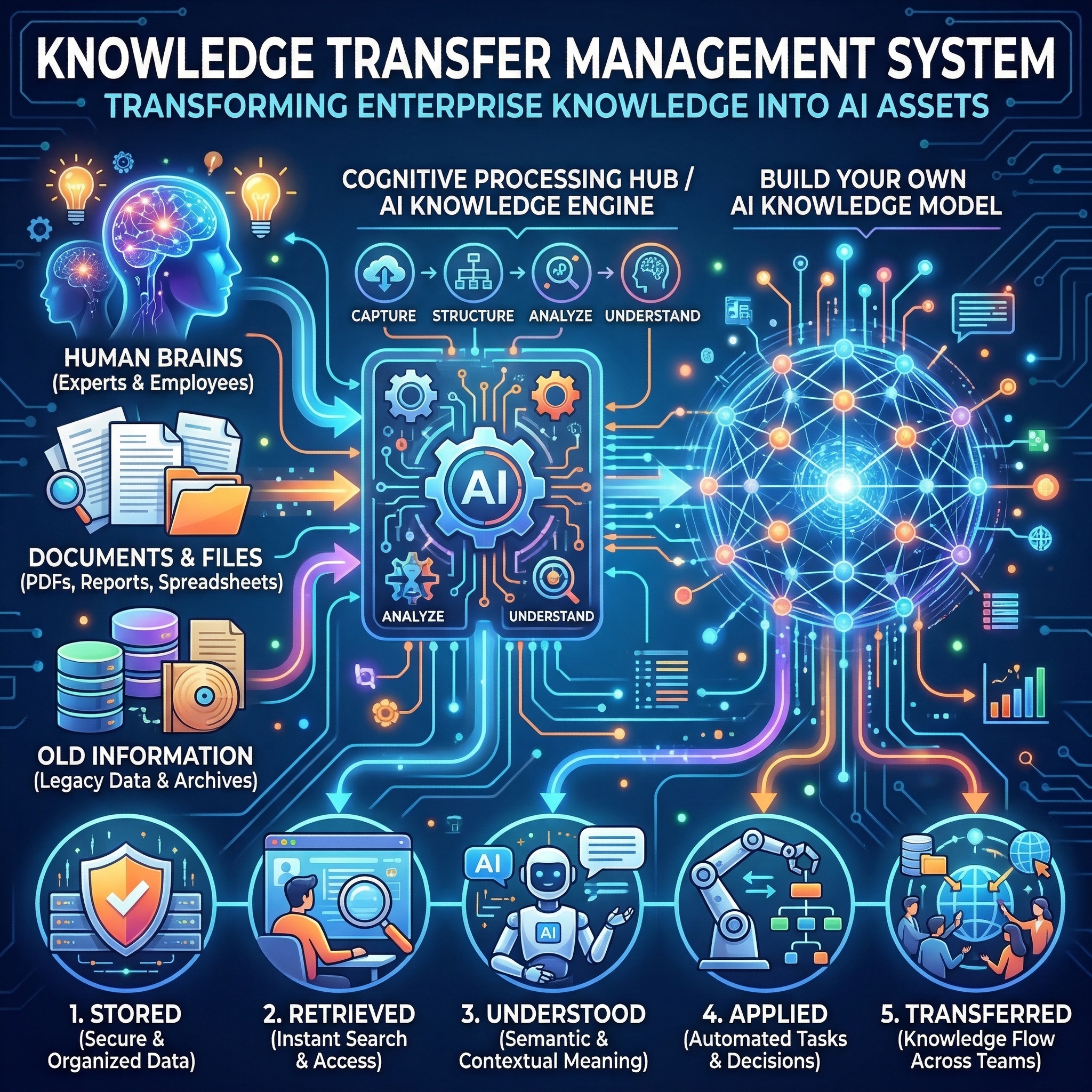
Transform Enterprise Knowledge from Human Memory, Documents, and Old Messages into Truly Transferable AI Assets


For many enterprises, the most important assets are not just customer lists or systems, but the knowledge hidden in employee experience, internal documents, SOPs, old cases, departmental practices, and management judgment.

When key employees leave, senior staff retire, departments reassign people, or process handovers are incomplete, what enterprises are most likely to lose are often these knowledge assets that are not immediately visible but are extremely valuable.

As Omnisenti Human First AI’s deployment partner in the Greater Bay Area, GoPeople helps enterprises build their own AI models, turning internal knowledge, working methods, process rules, case experience, and departmental intelligence into an AI knowledge system that can be searched, managed, transferred, and continuously evolved.

The core of a Knowledge Continuity Management System is not just building a knowledge base, but helping enterprises build their own AI knowledge model so that knowledge is not only stored, but can also be searched, understood, applied, and passed on.

Omnisenti AI carried by GoPeople


Preserve

Core knowledge and experience assets

Search

Find answers quickly with natural language

Transfer

Reduce knowledge gaps caused by staff turnover

What Can the Knowledge Continuity Management System Do?


  • Build an enterprise-dedicated AI knowledge model
  • Preserve internal knowledge, experience, SOPs, and case assets
  • Support knowledge search, knowledge organization, knowledge continuity, and internal training
  • Reduce knowledge gaps caused by the loss of key employees
  • Transform documents, FAQs, cases, policies, and departmental practices into searchable AI knowledge
  • Align with Guard Rails, Private AI, and enterprise security governance requirements

Human First AI Does Not Replace Experienced People, but Helps Pass Their Experience On


Omnisenti emphasizes Human First AI. Human First AI does not mean directly inserting AI into the enterprise. It means first understanding how people work, how knowledge is formed, how processes operate, and how departments collaborate, then building AI on top of those real needs.

Our AI service does not use AI to replace experienced people. Instead, it helps enterprises preserve people’s experience, methods, judgment, and knowledge, so new colleagues can take over more quickly, existing knowledge can continue more easily, and the overall capability of the team no longer depends only on a few individuals.

People are always the most important element. AI is not here to replace people, but to help enterprises retain knowledge, organize it well, and pass it on, so the team’s overall capability can accumulate instead of being lost because of staff turnover.

Omnisenti Provides Human First AI Knowledge Model Capabilities, and GoPeople Handles Industry-specific Deployment


Omnisenti Human First AI provides Private AI, Knowledge AI, Guard Rails, Ethical AI, and governable AI architecture capabilities, making it suitable for building enterprise-dedicated AI knowledge models and knowledge management platforms.

As the Greater Bay Area deployment partner, GoPeople helps enterprises transform knowledge management from “document accumulation” into a searchable, usable, and transferable AI knowledge platform based on different industry processes, departmental operations, business logic, and real management needs.

  • An AI model that can organize internal knowledge
  • A knowledge system that reflects departmental logic and working methods
  • A platform that supports new staff training, handovers, and internal search
  • A knowledge architecture that meets privacy, security, and permission requirements

Main Capabilities of the Knowledge Continuity Management System


1. Enterprise-Dedicated AI Knowledge Model

Build an AI model for the enterprise itself, allowing AI to provide support based on internal enterprise knowledge, documents, experience, and processes.

2. Knowledge Collection and Organization

Organize documents, SOPs, cases, FAQs, emails, internal notes, policies, and departmental practices into manageable knowledge assets.

3. Knowledge Search and Application

Employees can use natural language to search for processes, policies, past cases, handling methods, and internal knowledge, greatly reducing the time spent “asking others” and “looking for information.”

4. Knowledge Continuity and Handover Support

Retain the experience of senior employees, departmental habits, practical judgment, and handling logic to support new employee onboarding, role handovers, and departmental continuity.

5. Guard Rails and Permission Control

Set different permissions according to department, role, and data sensitivity, ensuring that knowledge search and model output are carried out within safe and controllable boundaries.

6. Ethical AI and Governance Framework

Establish output boundaries, auditable usage methods, and knowledge update rules to ensure the AI knowledge system remains manageable over the long term.

7. System Integration Capability

Can integrate with internal document systems, CRM, ERP, knowledge bases, email, internal platforms, and enterprise data sources, so the knowledge model is truly connected to daily work.


Knowledge Continuity Management System vs Traditional Knowledge Management Methods

Comparison Item
Traditional Method
Knowledge Continuity Management System
Knowledge Preservation Method
Knowledge is scattered across people’s minds, emails, WhatsApp, old documents, and verbal handovers, making it difficult to preserve systematically.
Organizes knowledge into a searchable, manageable, and continuously updatable enterprise AI knowledge model.
Search Efficiency
Employees rely on asking colleagues, reviewing documents, and searching old messages, which is inefficient and highly dependent on individuals.
Employees can directly use natural language to search internal knowledge, cases, SOPs, and working methods.
Staff Turnover Risk
When key employees leave, their experience and ways of handling work are easily lost as well.
Retains departmental experience and working logic as enterprise assets, reducing the risk of knowledge gaps.
New Employee Onboarding
New employees rely on apprentice-style teaching, which takes longer and produces inconsistent results.
New colleagues can quickly understand internal processes, knowledge, and handling methods through the AI model.
Security and Permissions
Knowledge is scattered, making it difficult to manage permissions by role and department.
Permissions and Guard Rails can be set based on department, role, and sensitivity to improve controllability.

What Value Does It Bring to Enterprises?


  • Prevent the Loss of Critical Knowledge: Retain knowledge hidden in senior employees and departmental experience, reducing the risk of gaps caused by staff turnover.
  • Improve Internal Search and Work Efficiency: Employees can find answers, processes, and cases faster instead of repeatedly asking others or reviewing documents.
  • Speed Up New Employee Learning and Training: Help new colleagues understand enterprise practices, working logic, and internal knowledge more quickly, lowering onboarding costs.
  • Build Knowledge Assets That Can Continue to Accumulate: Knowledge no longer stays with individuals, but becomes a core enterprise asset that can be continuously used and expanded.
  • Improve Departmental Consistency and Execution Quality: Enable different people and departments to have a more consistent understanding of processes, policies, and practices, reducing gaps and errors.
  • Support Long-term AI Platform Development: It can become the foundational knowledge core for AI Chatbot, AI Assistant, AI Workflow, and AI Comply.

Knowledge Continuity Management System Implementation Process

Step 1

Analyze the Enterprise’s Current Knowledge Situation

First understand which knowledge is currently the most important, the easiest to lose, and the scenarios that most urgently need continuity.

Step 2

Organize Knowledge Sources

Organize documents, SOPs, cases, FAQs, emails, departmental experience, and internal practices into a knowledge foundation.

Step 3

Build the Enterprise AI Knowledge Model

Create an AI model that belongs to the enterprise itself based on its knowledge content and departmental logic.

Step 4

Set Permissions and Guard Rails

Define different knowledge access scopes and usage boundaries according to department, role, and data sensitivity.

Step 5

Integrate Existing Systems

Connect the knowledge model into document systems, knowledge bases, CRM, ERP, or other internal platforms.

Step 6

Test and Optimize

Test search results, knowledge accuracy, and real-world usage, then continuously optimize the model and content.

Step 7

Official Deployment and Ongoing Knowledge Continuity

After launch, gradually expand into more departments, more knowledge scenarios, and more continuity needs.


Frequently Asked Questions

A Knowledge Continuity Management System is a knowledge platform that helps enterprises build dedicated AI models, allowing them to preserve, manage, search, and transfer internal knowledge, experience, and working methods more effectively.

A normal knowledge base mainly stores data. A Knowledge Continuity Management System transforms knowledge into searchable, understandable, and usable AI model capabilities, making it easier for employees to truly use the knowledge.

Not necessarily. Any enterprise with critical knowledge held by only a few people, high onboarding costs, or departmental handover and experience loss issues is suitable for implementation.

Omnisenti provides Human First AI, Private AI, Guard Rails, and knowledge model capabilities; GoPeople is responsible for deployment and integration based on the industry processes, business logic, and system environments of Greater Bay Area enterprises.

Yes. The system can help enterprises organize senior employees’ experience, cases, practices, and process logic into transferable knowledge assets.

Yes. The system can set different permissions based on roles, departments, and data sensitivity, ensuring knowledge is used within safe and controllable boundaries.

It can support internal knowledge search, new employee training, handover continuity, departmental FAQs, process search, case search, customer service support, and AI Assistant scenarios.

Yes. It can become the knowledge core for products such as AI Chatbot, AI Assistant, AI Workflow, and AI Comply.

Main Capabilities of the Knowledge Continuity Management System

Enterprise-Dedicated AI Knowledge Model

Build an AI model that belongs to the enterprise itself, so knowledge no longer stays only in documents and people’s minds.

Knowledge Collection and Organization

Organize SOPs, cases, FAQs, policies, emails, and departmental practices into manageable knowledge assets.

Natural Language Knowledge Search

Employees can directly use natural language to search processes, cases, and internal knowledge, reducing the time spent asking others and searching for information.

Handover and Onboarding Support

Help new employees take over work more quickly and make knowledge continuity more systematic.

Guard Rails and Permission Control

Set different knowledge access and output scopes according to department, role, and data sensitivity.

Private AI and Security Governance

Align with Private AI, Ethical AI, and enterprise-grade security governance requirements.

System Integration Capability

Can connect to document systems, knowledge bases, CRM, ERP, email, and internal platforms.